|

|
Management:
[Knowledge workers], and only they, own and control the most expensive of the means of production – their education – and their most important tool – their knowledge.
|
209 |
|
|
Management:
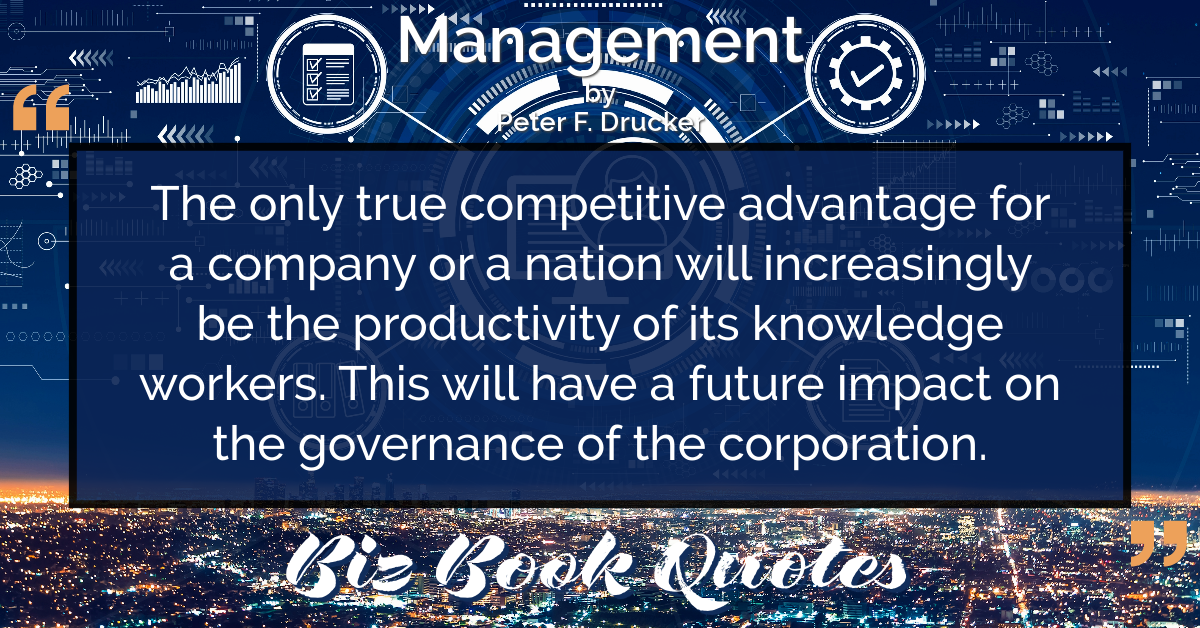
The only true competitive advantage for a company or a nation will increasingly be the productivity of its knowledge workers. This will have a future impact on the governance of the corporation.
|
209 |
|

|
Management:
…knowledge workers are not programmed by the machine… They largely are in control of their own tasks and must be in control of their own tasks.
|
209 |
|

|
Management:
Managers are the most expensive resource in most organizations – and the one that depreciates the fastest and needs the most constant replenishment.
|
235 |
|

|
Management:
A manager’s job exists because the task facing the enterprise requires it – and for no other reason.
|
239 |
|

|
Management:
The [manager’s] job has to have its own authority and its own responsibility. For managers must manage.
|
239 |
|

|
Management:
…a manager is someone who takes responsibility for, and contributes to, the final results of the enterprise, the job should always embody the maximum challenge, carry the maximum responsibility, and make the maximum contribution.
|
239 |
|

|
Management:
Both an age structure that is overbalanced on the side of youth and one overbalanced on the side of age create serious organization turbulence.
|
240 |
|

|
Management:
Managerial jobs should… be designed to allow a person to grow, to learn, and to develop for many years to come. There is little harm, as a rule, in a job that is designed too big.
|
240 |
|

|
Management:
…there are few things quite as dangerous as an organization in which promotions are so rapid as to become the accepted reward for doing a decent job.
|
240 |