 |
…recessions are precious things because they shake conventional wisdom, even complacent lean wisdom, and motivate managers to make hard choices.
|
336 |
 |
…the higher you climb in the hierarchy, the more oblivious the managers are likely to be – but at the same time, the more formal authority they tend to have.
|
126 |
 |
…extra managers are hired with the ostensible purpose of improving efficiency.
|
176 |
 |
Good bosses also spend time managing uncertainty and adapting the company’s strategy and structure by handling overall coordination between employees and units.
|
004 |
 |
…the basic problem of management and business – how to assemble, organize, and motivate groups of people and resources to produce the goods and services consumers want – is the same as it ever was.
|
013 |
 |
Paradoxically, management and hierarchy can help companies become agile and adaptive.
|
016 |
 |
…meeting the demands of the current environment has made managerial authority even more essential than it was in earlier periods.
|
016 |
 |
Managers need to move away from specifying methods and processes, in favor of defining the principles they want people to apply or the goals they want people to meet.
|
019 |
 |
In the knowledge economy, the main task for top management is to define and implement the organizational rules of the game.
|
020 |
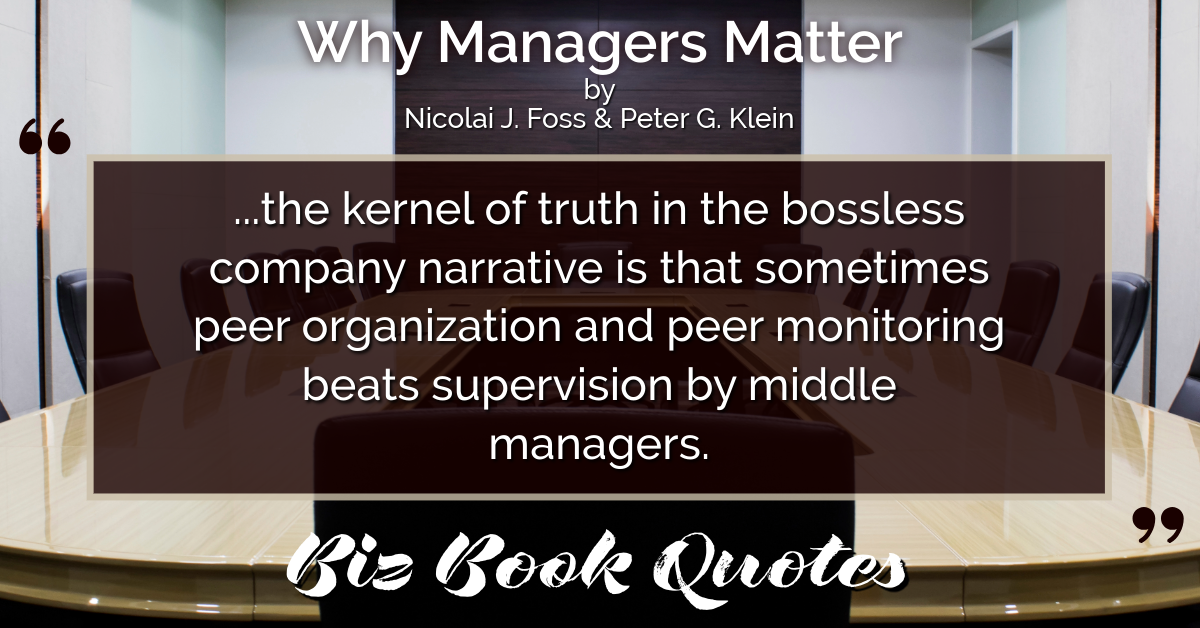 |
…the kernel of truth in the bossless company narrative is that sometimes peer organization and peer monitoring beats supervision by middle managers.
|
032 |